Components#
The parts catalog. Wire, switches, resistors, capacitors, coils, transformers, and the relays and meters the operator wires into a circuit before the chips arrive.
Catalog#
Symbol |
Photo |
Component |
|---|---|---|
|
|
Wire and cable. Copper conductor in PVC or rubber dielectric. Carries every signal and rail on the bench; a few inches at the right point reads anything that runs through. |
|
|
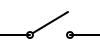
Switches. Mechanical break in a circuit. Push, toggle, slide, rotary, tilt (mercury switches in vibration bugs), or reed (magnetically actuated for concealment). |
|
|
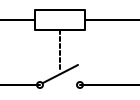
Relays. A switch driven by an electromagnet. Logic-level coil commands a power-level contact; the basis of any electrically isolated kill switch. |

|
|
Moving coil meters. Analogue current and voltage display. Needle deflects with current through a coil in a permanent magnet; the dial face on every classic TSCM detector. |

|
|
Microphones. Sound to electrical. Carbon, dynamic, condenser, contact, or MEMS. The carbon mic was the spec for half a century of phone taps. |

|
|
Speakers. Electrical to sound. Voice coil in a magnetic gap drives a cone or dome; the piezo earpiece is the covert sibling. |
|
|
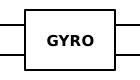
Gyro. Angular rate sensor. Reports rotation about each axis; MEMS variants are tiny and cheap. |
|
|
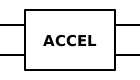
Accelerometer. Linear acceleration sensor. Detects gravity and motion; pair with a gyro for an IMU. |
|
|
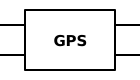
GPS. Satellite positioning module. NMEA out, antenna in, fix in tens of seconds. |
|
|
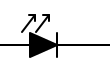
IR. Infrared LED or photodiode. Emits or detects 850–950 nm light for remote control and proximity. |
|
|
EM. Electromagnetic field sensor. Magnetometer, Hall, or fluxgate; reports field strength and direction. |
|
|
mmWave. 24–77 GHz radar. Detects motion, presence, and velocity through plastic and clothing. |
|
|
Pressure. Pressure sensor. Barometric, gauge, or differential; piezoresistive or capacitive. |
|
|
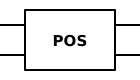
Proximity. Non-contact detection. Inductive, capacitive, or optical; reports presence within range. |
|
|
Position. Position transducer. Potentiometer, encoder, LVDT, or resolver; absolute or incremental. |
|
|
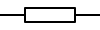
Resistors. Two-terminal passive that opposes current flow. Bias networks, voltage dividers, current limiters; the cheap part that survives the operator’s mistakes. |

|
|
Capacitors. Two parallel plates separated by a dielectric. Stores charge; passes AC and blocks DC. A coupling cap lifts audio off a line tap without shorting the DC bias. |
|
|
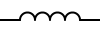
Coils. Inductor. Stores energy in a magnetic field and resists changes in current. Pair one with a capacitor and you have the tuned tank of every superhet receiver. |
|
|
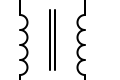
Transformers. Two coupled coils on a shared core.
Steps voltage up or down by the turns ratio; the
|

|
|
Batteries. Primary power for any standalone implant. Button cell to lithium primary; capacity sets the device’s listening time. |
|
|
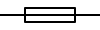
Fuses. Sacrificial wire link. Opens when current exceeds the rating; protects expensive parts from cheap mistakes. |
|
|
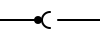
Connectors. Physical interface. USB, RJ11, RJ45, coax, GPIO. Every implant either replaces a connector or rides on one. |
|
|
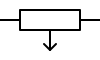
Solenoids. Coil that pulls a ferromagnetic plunger when energised. Doorbells, lock strikers, the hammer in a pick gun. |

|
|
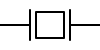
Antennas. Conductor cut to a fraction of the wavelength. Every wireless bug, beacon, and SDR has one; cavity, dipole, whip, helical, or patch. |
|
|
Crystals. Quartz slab cut to a resonant frequency. Sets the carrier in transmitters and the clock in any micro. |

|
|
Piezo elements. Ceramic disc that flexes with voltage and generates voltage when flexed. Buzzers, contact mics, the tones in a blue or red box. |
References#
Electricity for the underlying laws.
Semiconductors for the active parts that consume these.