Semiconductors#
The active devices etched into a semiconductor substrate. Diodes, bipolar and field-effect transistors, the unijunction transistor, and the thyristor family (SCRs and triacs). The first layer where current becomes a switched or amplified thing; the active core of every Cold War bug, blue box, and modern implant.
Diodes#
One-way current valves. The simplest semiconductor device; a p-n junction that conducts in one direction and blocks the other. The operator meets diodes as rectifiers in power rails, voltage references on radio boards, and detectors in RF front ends.
Symbol |
Photo |
Component |
|---|---|---|
|
|
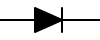
Diode (signal). General-purpose p-n junction. One-way current valve; the lone part inside a phone phreaker’s black box. |
|
|
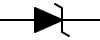
Zener diode. Reverse-biased voltage reference. Held a stable rail for one-way agent radios long before the LM78xx existed. |
|
|
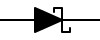
Schottky diode. Fast metal-semiconductor junction. Mixer and detector in RF front ends; the diode of choice for an SDR’s quadrature mixer. |
Transistors#
Three-terminal active devices. A small control input (current for bipolar, voltage for FETs) gates a much larger output current, the property that turns a transistor into an amplifier, a switch, or a relaxation oscillator. The workhorses of every analog stage, digital gate, and switching power supply on the operator’s bench.
Symbol |
Photo |
Component |
|---|---|---|
|
|
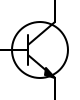
Bipolar transistor (NPN). Three-terminal current amplifier. Active part in every Cold War body wire, crystal radio, and one-transistor bug. The 2N2222 is the family ambassador. |
|
|
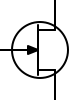
JFET. Voltage-controlled current with very high input impedance. The 2N3819 is a classic preamp for electret mics and high-impedance probes. |
|
|
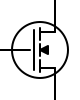
MOSFET. Same role as JFET; the workhorse of modern digital logic, switching power, and any implant that runs on a coin cell. |
|
|
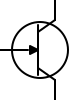
Unijunction transistor. Negative-resistance trigger. Relaxation oscillators in time-delay relays and older sweep generators. |
Thyristors#
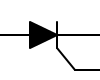
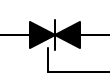
Latching switches. Once triggered, a thyristor conducts until the current through it falls below a holding threshold, so a small gate pulse can commit a large load for the rest of a half-cycle. The operator meets thyristors in AC line control, capacitor-discharge ignitions, and any device that flips a mains-side load on command.
Symbol |
Photo |
Component |
|---|---|---|
|
|
SCR. Latching switch for DC and AC half-cycles. Lamp dimmers, capacitor-discharge ignitions, stun-gun output stages. |
|
|
Triac. Bidirectional SCR. Full-cycle AC control; mains-side switching for any device that flicks a wall outlet on command. |
References#
Photonic Semiconductors for light-sensitive semiconductors.
Digital Integrated Circuits for digital chips built from these primitives.